Technical Large Animal Emergency Rescue (TLAER TM) discusses the practical, technical considerations behind the specialty heavy rescue and safe extrication of live large animals in local emergencies (trailer overturns, mud, ice, barn fires, etc.) and disaster areas, while teaching people how to do it safely without injury of the animal or themselves. It focuses on behavior and how it affects human attempts to extricate large animals.
Bookmark this page. Below you will find all the resources we could find that will support you moving forward after the TLAER Awareness Class. Links to connect with Dr. Husted, scene management, care vs welfare, links to buy reputable rescue equipment, field euthanasia, and much much more.
Learn more:
| TLAER Facebook Study Group | This FB group is intended for ANYONE who is interested in emergency management and response, and the prevention and mitigation of issues with large animals. We are interested in the welfare and professional, humane treatment of animals in these situations, and agriculture in general. | TLAER Facebook |
| TLAER YouTube Playlist | There are a bunch of TLAER related videos and webinars here – all free and in more details for most than we were able to cover in the event this weekend. | TLAER YouTube |
| TLAER.org | TLAER is the practical considerations, behavioral understanding, specialty equipment, techniques, methodologies and tactics behind the safe extrication of a live large animal from entrapment (trailer wrecks, ditches, mud, barn fires) in local emergencies and disaster areas. | Website |
| Homework | To help you put the knowledge and skills to work after attending the TLAER course! Each is a downloadable PDF. | Students Trail Riders Facility_Safety |
| Rescue Equipment | There are plenty of sources for equipment out there, but here is the list provided by Dr. Husted: HASTPC Rescue – online equipment resource store 4HLAS Store – online equipment resource store EBSP Rescue – Course book source (ships from Canada) | Awareness Course List Operation Course List |
Extensive Additional Resources and Links ↓
Care VS Welfare
Care is the actions taken to provide for something (food, water, shelter, veterinary care), while welfare is the state of something as a result of the care it receives, such as an animal’s mental state, nutrition, health, behavior, and environment.
The concept of animal welfare has evolved over time. The way we think and talk about welfare, and what we know today, has changed more in the last 50 years than it did in the previous 500. The result is great confusion over what welfare is, and what is not.
Read more about Care vs Welfare…
| Resources on Happy Horses | ||
| EQUICULTURE teaches horse owners how to manage their land. | Free 1 hour course – intro to pasture management & welfare | |
| Educating owners and managers to improve the health and welfare of senior equids. | MySeniorHorse.com | |
| The Five Domains Model first appeared in 1994 and has undergone many revisions and updates as the scientific knowledge has improved. – Nutrition and Hydration – Physical Environment – Health and Fitness – Behavioral Interactions – Mental State | Welfare and the 5 Domains – from author Christina Wilkins | |
| June 2024 – In the run up to this summer’s Olympics and Paralympics, and a forthcoming review of British racing’s welfare strategy, an invited panel debate findings of a new public opinion survey commissioned by World Horse Welfare. | Social License in Horse Sport – World Horse Welfare | |
| Pain and Fixing Behavioral Problems | ||
| The 24 Behaviors of the Ridden Horse in Pain is an award winning film that dares to challenges the way we look at “badly behaving” horses, and addresses common behavioral signs of discomfort. | 24 Behaviors of the RIDDEN HORSE in PAIN – Dr. Sue Dyson | |
| Is My Horse In Pain? An evidence-based guide with 30 scientific references: | Complete Guide to Equine Pain Assessment | |
| Pain management is important for optimal recovery and good welfare for all patients, including in equine practice. Horses are prey animals and are notorious for trying to hide signs of pain, so the accurate and careful assessment of the clinical signs of pain is essential for equine welfare. This article will discuss different pain scoring methods for use with equine patients. | Pain Scoring as used by Vet Nurses in Horses | |
| The Colorado State University Equine Comfort Assessment Scale has standardized how we look at a horse’s general attitude and how we can identify early pain signals. | Equine Comfort Assessment Scale | |
| Do you know how to assess your horse’s level of fear? | Equine Fear Assessment | |
| Training Large Animals | DON’T BREAK YOUR VET! Equine vets have one of the highest injury risks of all civilian professions. To help address this serious issue the British Equine Veterinary Association (BEVA) has produced a series of short videos, featuring vet and equine behaviorist Gemma Pearson, providing quick and simple ways of teaching horses to be quiet, relaxed and safe for injections, clipping, worming, examinations and other veterinary procedures. | Webinar series on how to prep your horse for the vet visit |
| The psychology of learning, clicker training and bitless riding from World Bitless Association: | Positive Reinforcement Training Basic Introduction | |
| Principles of Humane Equine Training from the Intl Society of Equitation Science: – Regard for human and horse safety – Regard for the nature of horses – Regard for horses’ mental and sensory abilities – Regard for current emotional states – Correct use of habituation/desensitization/calming methods – Correct use of Operant Conditioning – Correct use of Classical Conditioning – Correct use of Shaping – Correct use of Signals/Cues – Regard for Self-carriage | First Training Principles |
Scene Management
| Scene Management | Brevard County, Florida created a Basics Guide for Large Animal Incident Response. This is a great tool for counties in our area who may want to create their own guide for incidence response. | DOWNLOAD PDF – Large Animal Incident Response Guide |
| NFPA 1670 This standard identifies and establishes levels of functional capability for efficiently and effectively conducting operations at technical search and rescue incidents while minimizing threats to rescuers. | NFPA 1670 | |
| Colleague Jim Green in UK videos: | MULTIAGENCY RESPONSE TO LARGE ANIMAL INCIDENTS MAKING LARGE ANIMAL RESCUE SAFER | |
| Washington Sasquatch Research Team (WASRT) Resources: | Managing the Head of the Prone Horse Emergency Halter General Strop Techniques | |
| Barn Fires | Please reference the TLAER textbook – link. AAEP Publication by Husted & Morauw | Download PDF |
| Loose Animals | Loose animals are scared animals and scared animals are dangerous animals. Whether as a result of a livestock truck accident, barn or pasture escape, when farm animals get loose, there is great risk that an animal is going to get hurt or killed, a human is going to get injured and property is going to get damaged. | |
| Webinar/Interview with Dr. Husted on catching loose horses | YouTube video | |
| Ontario Farm & Food Care – Farm Animals on the Loose | Download PDF | |
| Vehicle Accidents Involving Livestock Trailers | We strongly recommend that you reference the TLAER textbook for this topic (link to purchase at the top of this page) or attend an TLAER Operations level course. | |
| The Brevard County, Florida Large Animal Incident Response Guide includes a reasonable basics overview on Page 13 (Section 5). | DOWNLOAD PDF – Large Animal Incident Response Guide | |
| Large Animal Manipulations and Hypothermic Large Animals | TLAER YouTube Video Playlist of Manipulations | Videos of Rescues, Drags, Mud, and More |
| The reference sheets in this link have been developed as a quick reference tool for the various manipulation techniques used in Large Animal Rescue. Their intended use are for those persons that have successfully completed a hands on workshop in Large Animal Rescue offered by Equine Guelph. | Large Animal Manipulations Reference Sheets (recumbent, cast, trapped) | |
| DOWNLOAD PDF – The Hypothermic Horse DOWNLOAD PDF – AAEP Recumbent Equines DOWNLOAD PDF – AAEP Restraint Recumbent Horse | DOWNLOAD PDF – Cast horse roll DOWNLOAD PDF – How to manage a down dairy cow | |
| Field Euthanasia | Iowa State University College of Veterinary Medicine | Humane Euthanasia of Sick, Injured, and/or Debilitated Livestock Printable Wall Poster Printable Wallet Cards |
| Flyer from California Dept of Food and Agriculture | 2 Page Flyer | |
| American Association of Equine Practitioners | AAEP Euthanasia Guidelines | |
| American Veterinary Medical Foundation | How do I know it’s time? Making the Decision (Downloadable PDF) AVMA Guidelines for the Euthanasia of Animals: 2020 Edition | |
| Intrathecal Lidocaine Euthanasia | Iowa State University Llyod Veterinary Medical Center. “Intrathecal Lidocaine Euthanasia Procedure in Equids” | 2 page PDF |
| “Electrophysiologic Study of a Method of Euthanasia Using Intrathecal Lidocaine Hydrochloride Administered during Intravenous Anesthesia in Horses” – a PubMed National Library of Medicine study that details the science behind the intrathecal lidocaine euthanasia method. | Full Study | |
| Article on the American Association of Equine Practitioners (AAEP) updating their guidance for humane euthanasia of a horse to include intrathecal lidocaine. | TheHorse.com article | |
| Floods, Severe Weather, and Natural Disaster | “2023 Equine Evacuation and Transportation Best Practices” from The National Alliance of State Animal and Agricultural Emergency Programs (NASAAEP) is an organization that shares best practices for animal disaster. | Read NASAAEP 2023 Best Practices |
| Horse Transport | “Non-Commercial Horse Transport: The need for standards” – by Creiger and Husted. Available on: | Acedemia.edu Researchgate.net |
| Trailer Safety | Dr. Husted’s Downloadable PDF’s | Trailer Safety Hitch Checklist |
| Purdue University publication “Understanding the Horse Trailer Rig” | Order the Book | |
| Frisian Horse Association Webinars on YouTube | Part 1 Part 2 | |
| Trailering in Winter | US Rider Resource on trailering in freezing temperatures | Download USRider PDF |
| Conspicuity Tape | pre-done edges, “caution horses”, various colors, etc | Reflective Pro |
| * there are cheaper products out there that you can find – but Rebecca can’t recommend them.* | Rolls of tape | Reflective Pro 3M Scotchlite |
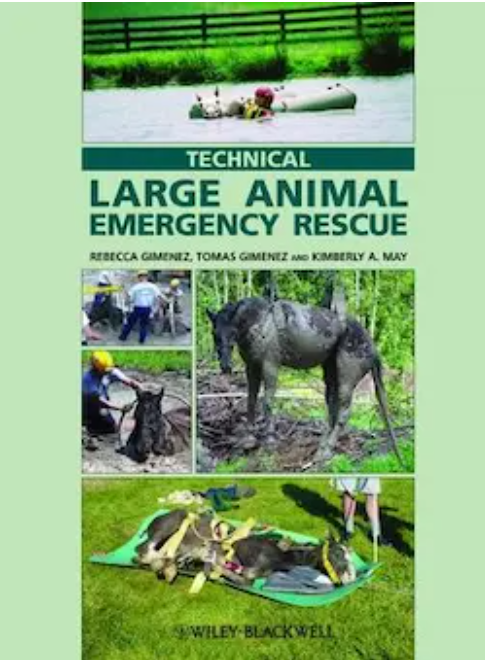
Technical Large Animal Emergency Rescue textbook
Add Dr. Husted’s textbook to your library! Technical Large Animal Emergency Rescue is a guide for equine, large animal, and mixed animal veterinarians, zoo and wildlife veterinarians, vet techs, and emergency responders on how to rescue and treat large animals in critical situations while maintaining the safety of both the animal and the rescuer. This book is a must-have reference for any individual who deals with large animals in emergency situations.